Cambria Estate ‘Julia’s Vineyard’ 2018 – Infinitely drinkable!

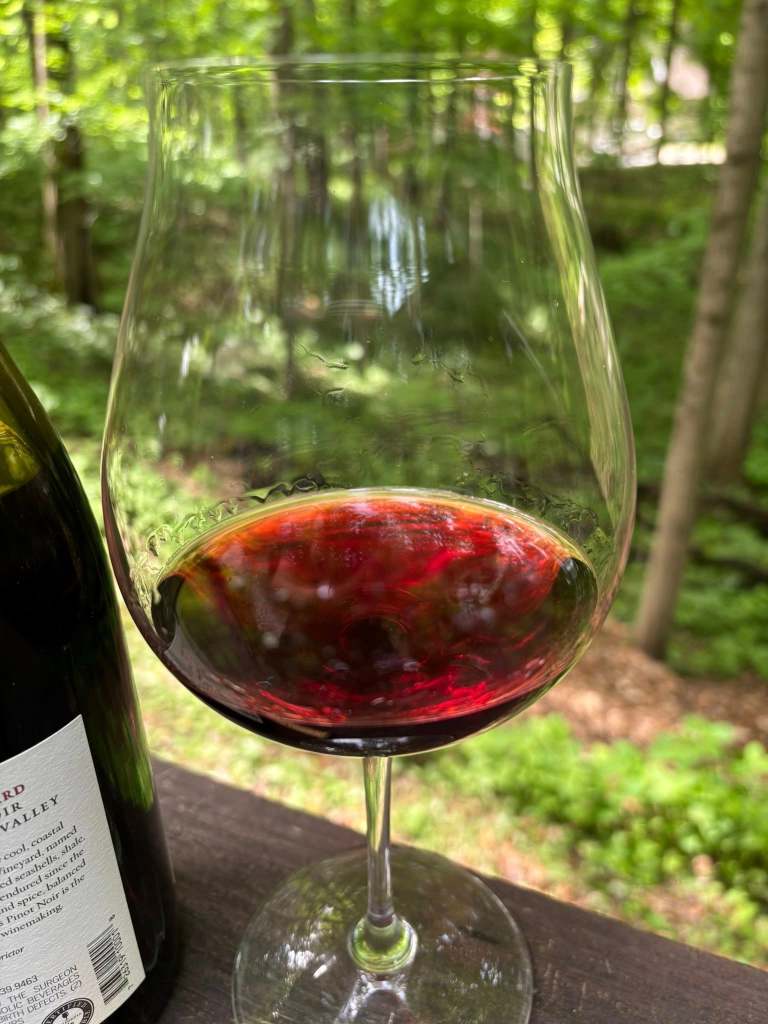
First impression from the nose is loads of cherries, cola, dark raspberries, and an earthy leather note to round things out.

One sip and I am convinced this is one of the best Pinots on the market that sits around $25. This is classic cool climate, coastal elegance sourced from a single vineyard in Santa Maria Valley in Santa Barbara County. Between the fog keeping the vines cool and the unique characteristics of the soil consisting of ancient fossilized seashells, shale, limestone, and sand, this vineyard produces a Pinot that drinks way beyond its price point, that is infinitely drinkable.

This is an all women affair with proprietors Katherine and Julia Jackson and head winemaker Jill Russell who joined the team in 2017. The vineyard was renamed in 1988 in tribute to Julia Jackson.

Silky soft mouthfeel greets your first sip with a balance of delightful fruit, elegance, and restraint, with well-integrated fine grain tannin. Impressive layers of cherries, pomegranate, strawberries, and raspberries dominate with secondary notes of cranberries, cola, oak, with just a hint of an earthy leather note and spices on the lengthy finish.

For a flagship wine this is an over achiever, not surprised it received a 92 Pt rating from Wine Enthusiast.  

This will cellar out to 2028 with confidence. I still have a few bottles in the cellar so look for updates in the future.

Pairing should include grilled Salmon on cedar plank, Chicken Salad with a Raspberry dressing, Turkey, or Pork with cranberry sauce.

A few quick observations: this is my first photo outside this year, summers here, finally. I have several Pinot glasses of different shapes, but I also seem to revert to old school from Riedel- I think they work best.

Groth Estate Chardonnay 2022- new world with an old-world soul.

All the grapes were sourced from the Hillview Vineyard which was acquired in 1982. This 44-acre Vineyard was acquired for its Merlot but almost half was replanted with Clone 4 (Wente) and Clone 76 (Dijon) after realizing its potential for world-class Chardonnay.

Ted Henry, their winemaker, came on board in 2021 as Director of Winegrowing, after cutting his teeth at Clos du Val for 5 years, and Jarvis Estate.

An immediate richness is present as the wine is poured into the glass with baked apple pie, vanilla, and pear, with traces of butterscotch and ginger escaping from the glass.

The palate is smooth, rich, and creamy, coating your mouth. This is beautifully balanced with impressive acidity, all wrapped in elegant complexity and appeal. Intertwined layers of ripe Fuji apples, pears, peaches, papaya, orange peel, lemon plum, and an interesting sesame seed/caramel thing going on—reminiscent of a sesame candy bar I used to eat, growing up in Australia.

Ginger, lemon curd, and spices round things out, delivered on a long finish.

If you like your Chardonnay big, bold, and opulent without the overly oaky buttery notes, then this is right up your alley. It has great balance on display, walking somewhere between bold and elegant. The 14.9% alcohol is not at all evident.

Cellar out to 2030 with confidence.

Any seafood, shellfish, chicken, or pork will pair well with this wine.

What has 42 ha and 70 plots and is delicious to drink? …

Chateau de Pez of course!

About the Winery …

It is possibly the oldest Bordeaux wine-making estate in the Saint Estéphe appellation, rivaled only by Chateau Calon Segur. The Chat. de Pez estate was created in 1452 by Jean de Briscos and has since passed through many owners with Jean-Claude Rouzaud being the current owner and custodian since 1995. If you are curious about the name, he is best known for the Roederer Champagne, the maker of Champagne Cristal, as well as owning Pichon Comtesse de Lalande in Pauillac, Chateau Bernadotte, and Chateau Haut-Beausejour.

The vineyards are 48% Merlot, 46% Cabernet Sauvignon, 4% Cabernet Franc, and 3% Petit Verdot planted on gravel, limestone, and clay soils. A 17-meter altitude difference produces excellent drainage for the vines, which are an average of 25 years old. Their average annual production is around 18,500 cases.

Due to substantial investment reflecting the jump in quality, the Chateau has had a string of outstanding vintages from 2014 to the current vintage- 2023.

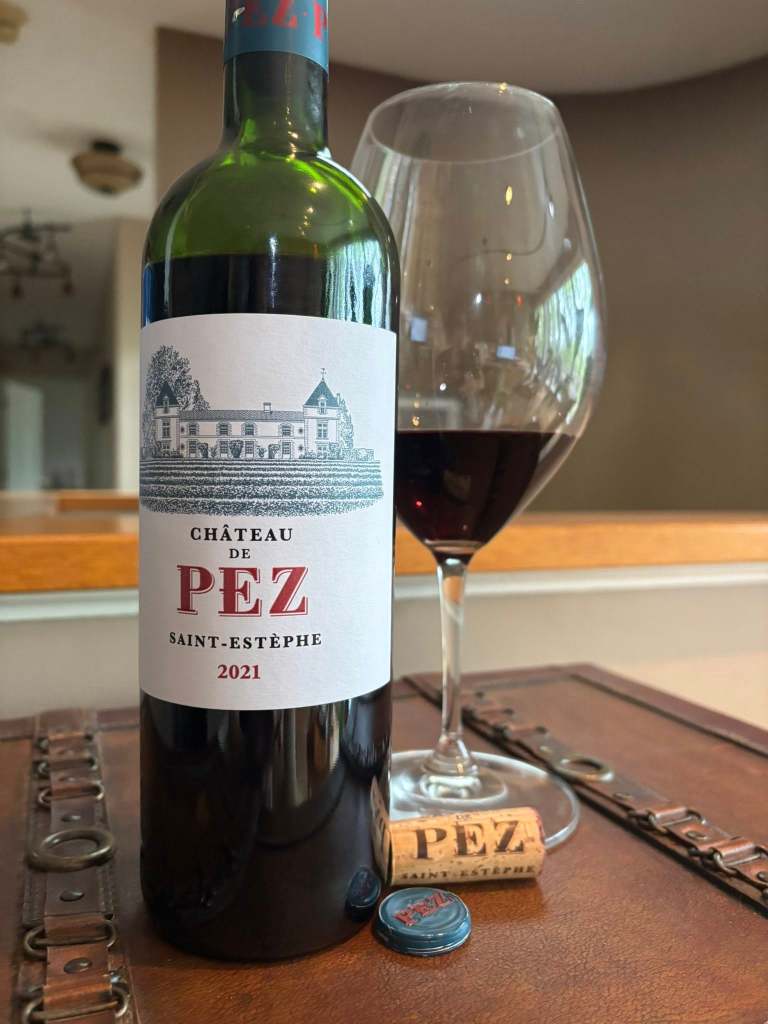
Chateau de Pez 2021   

The 2021 vintage is a blend of 51 % Cabernet Sauvignon, 43 % Merlot, 3% Cabernet Franc, and 3 % Petit Verdot.

Expressive aromas of ripe red cherries, wildflowers, plums, blueberries, and spices.

The palate is inviting, silky smooth, almost creamy, with enticing ripe dark cherries, blueberries, blackberries, red plums, and dark chocolate dominating with savory/earthy notes, coffee, olives, and spices. This wine displays impressive depth and complexity with great balance and acidity. Tannins still give a dryish pucker, after all, it is only 6 years old. I anticipate this will soften in the coming years, 2 -3 hours of decanting in the meantime.

This was impressive drinking day 2 with just the cork back in the bottle.  

This will cellar out to 2035 nicely with marked anticipated improvements.

Winery recommends the following pairings: veal, pork, beef, lamb, duck, game, roast chicken, roasted, braised, and grilled dishes as well as mushrooms, pasta, and cheese. Chateau de Pez is also quite good with Asian dishes, and hearty fish courses like tuna, mushrooms, and pasta.

Two Hands Gnarly Dudes Shiraz 2016 – from the cellar.

The idea of Two Hands Winery came together when Michael Twelftree and Richard Mintz, were attending a friend’s engagement party and discussed making wine and producing the best possible Shiraz from iconic regions in Australia. That was 1999.

 A lot of water has gone under the bridge, with more vineyards being acquired stretching from the iconic Barossa to the cooler climate of Yarra Valley in Victoria.

Fast-forward to 2015, and a changing of the guards when Colorado native Tim Hower joined forces with Michael, becoming the other ‘Hand’ in 2015. This led to the acquisition of several new vineyards, including the Holy Grail site on Seppeltsfield Road in Barossa. Locals know this as The Avenue of Hopes and Dreams and it is lined with 100-year-old date palm trees- I remember being impressed by the majestic splendor of this road running through the middle of this iconic wine region when I first saw it in 1986.

This wine is named after the ferocious and twisted-looking old vines from which this wine is made.

The first thing you notice is the amazing color of this wine. Then the sensation of the aromas impresses you with layers of ripe blackberries, black currants, subtle black pepper, and baking spices adding an urgency to taste this, Shiraz.

The palate is big, rich, and seductive with a silky-smooth mouthfeel that has evolved since its birth 9 years ago. Depth and complexity characterize this Barossa gem, framed with matt finish tannins and excellent balance. Intertwined layers of ripe blackberries, plums, blueberries, and black currants leave little room for

for secondary notes of dark cherries, vanilla, dark chocolate, black pepper, and baking spices. There is so much going on with this wine. Great length on the finish.

Fire up the grill, this needs a steak from the grill, gourmet beef burgers, or just about any red meat from the grill.

I would anticipate further surprises evolving from another 3 – 5 years of cellaring. 

I can see why James Halliday gave it a 94 Pt rating.

Florian Mollet Roc de l’Abbaye Sancerre Blanc 2023

The story of the Estate started in the 15th century when the local Abbey identified 4 hectares of the highly coveted flint or Silex soil, and named it Domaine du Clos du Roc- which translates to ‘enclosure of the rock’.

These 4 hectares are one of the finest vineyards in the region, becoming part of Domaine Roc de L’Abbaye in 1973 through the marriage of Jean-Paul Mollet and Rosie-Marie Maudry.

A mere 15% of Sancerre is home to the silex soil which produces wine of extraordinary depth characterized by aromas of gunflint, expressive minerality, and acidity, with balance and linear precision. This wine bears all these qualities and more.

Aromas of green apple, lime, peach, gunflint, and just a hint of honey, issued an enticing invitation to taste.

The palate is crisp, clean, and mouthwatering due to racy acidity and a distinctive wet stone-like minerality. At the core of this appealing wine are layers of crisp green apples, Meyer lemons, limes, white peach, and saline with just a hint of green melon and honey. This is a very tempting potpourri of flavors that will not disappoint.  

Food pairings should include Asparagus, Ceviche, Shellfish, Crab Cakes, and Roasted Chicken. If you want to make cheese, try Chevre or Goat cheese.

I have tasted 5-year-old Sancerre’s and have still retained their crispness and acidity. This could cellar out to 2030 without a problem.

D de Dassault Saint Emilion Gran Cru 2016

The Chateau was established in the mid 1800’s by the Fourcaud Family of Chateau Cheval Blanc fame, and was named Chateau Couperie after its address. In 1955 the property was acquired by Serge Dassault and promoted into the “Grand Cru Classé” in 1969. The Winery underwent some serious quality development programs, and in 2012 forged a commercial and technical relationship with Domaine Baron de Rothschild.

Overall, the 2016 vintage for Saint-Émilion was excellent with some degree of inconsistency. It was known for a wide range of excellent easy drinking wines as well as heavyweights needing cellaring for decades to come. Michel Rolland is the Consulting oenologist- more reason to want to taste this.

This is a blend of 70% Merlot, 12% Cabernet Franc, 8% Cabernet Sauvignon sourced from old siliceous and sandy limestone soils and aged for 12 – 14 months in 100% one year old barrels.

Expressive notes of dark fruits- blackberries and black currants, plums, and dark cherries, with a subtle pepper and vegetal note.

This youthful wine, while still evolving, has charm and charisma with obvious synergy between the varietals.  Lovely black and red fruits dominate the palate with

secondary notes of coffee and dark chocolate complimenting spices, oak, and tobacco. Smooth mouthfeel with great balance and acidity and tannins in check. Smooth elegant finish with impressive length.

I can see this cellaring out another 10 years, to 2035.

Food pairings should include your favorite red meat dishes, game, and pepperoni pizza.

Final thought: yes, to my surprise, the cork split, and only 9 years old.

Penfolds St Henri 2019- another classic release.

I bought this bottle on a recent trip to Australia, you can tell because it is under a screwcap, all the US releases are under cork. I do not know why there is still pushback against screwcaps, which are, arguably the best closures for wine. 

This is one of my all-time favorite wines which, since its initial release in 1957 has set a standard that has been virtually unmatched by any other wine in its price point, especially after a revival in the 1990’s. In Australia, it is still under $120 and has consistently gained ratings in the mid to high 90’s.  The 2018 gained four 99 Pt ratings, from two US and two Australian reviewers.

This release has received ratings of 96 Pt- Wine Advocate, 97 Pt- James Suckling, and 98 Pt- Tony Love.

It showcases seductive aromas of blackberries, plum, black currants, dark chocolate, leather, white pepper, and mint. This really needs 3 – 4 hours decanting to reveal all the hidden delights. A few hours after opening, notes of cooked meat, cranberry, and leather developed.

The palate is velvet-smooth with rich lush fruit that displays remarkable depth and complexity. It walks that thin line between restrained elegance and bold character with attitude. It never feels a need to show off. Take your time with this one, it is worth it.

Seamless layers of blackberries, black currants, plums, dark chocolate, leather, and licorice dominate with secondary notes of vanilla, tobacco, mint, cranberries, and mulberries. There is a subtle sweetness that oozes from between the layers of fruit that only adds to the assertion that this is an outstanding wine that will continue to improve over the coming decades- cellar out to 2050 plus with confidence.

It will be arriving in the US soon, so get yourself a six-pack and enjoy it over the next 25 to 30 years.

Copain Daybreak White Wine 2023- Aromatic, delicious, mouthwatering, food friendly- perfect for summer.

Quick word about the winery …

Copain was established in 1999 by winemaker Wells Guthrie and Kevin McQuown and quickly became known for Chardonnay, Pinot Noir and Syrah. The Jackson Family purchased the winery in 2016 and maintained the emphasis on varietal wines, whilst bring to the table a commitment to sustainability and climate action. Their Rooted For Good initiative includes five facets: social responsibility, climate action, land conservation and farming, water management and global leadership through action. The Jackson Family Wines are founding members of the International Wineries for Climate Action.

This wine was launched a few years ago with the first release from the 2022 vintage and comprised seven varietals.

After tasting this, I had to smile at the totally under stated wine description: ‘White Wine’ There is no indication of the grape varietals, or the skill involved in blending this wine. The blend is 37% Malvasia Bianca, 29% White Riesling, 13% Gewürztraminer, 9% Chenin Blanc, 8% Viognier and 4% Chardonnay, sourced from some exceptional sites in Sonoma. The winemaker/blender is Ryan Zepaltas- excellent job. Infinitely drinkable.

Bright floral notes and tropical fruits jump from the glass, that can only come from the Gewurztraminer- unlike Alsace but enticing and distinctive nevertheless. Aromas of honey, mango, tea and rose petals draw you in.

The palate is complex, packed full of flavor balanced by crisp, mouthwatering acidity. Interwoven layers of lychee, nectarine, mango, and pineapple make you a believer, the secondary layers of pear, honeysuckle, and guava are icing on the cake. This is tropical fruit salad in a glass, only better.

Everything is where it should be, wonderful structure and texture on the palate. Great length on the finish.

Re pairings, Scallops, shellfish, spicy Indian curries, Chicken Pad Thai, or Spicy Fish Tacos all came to mind.

This will cellar out 2-3 years but I think this is drinking so well now, enjoy this summer. There is another vintage around the corner.

Wine Enthusiast gave this a 91 Pt rating. A little conservative, I think.

Nangkita Cabernet Premium Edition 2021- wonderful wine from a relatively unknown AVA.

The vineyard is nestled in the rolling hills of the Southern Fleurieu region that is only a 50-kilometer (or 27 mile) drive from Adelaide, just south of McLaren Vale- about half way to Langhorne Creek. The vineyards are cooled by winds from Alexandrina Lake, somewhat like Coombsville AVA in Napa that is cooled by winds from ‘San Francisco Bay’ back waters.

It is relatively unknown region compared to McLaren Vale- a shame because its cooler climate produces wines of restraint and elegance. I lived in Adelaide from 1986 to 1996 and the region was barely mentioned then, and I had driven through it several times.

The vineyard consists of 43 acres sitting on a northeast slope with elevations between 135 – 185 meters featuring deep sandy loam, approximately 1 – 1.5 meters overlaying clay and limestone.

Opulent notes of black currant, blackberries, and spices dominate the nose and draw you in. Allow it to open and a menthol/mint/eucalyptus note develops.

Bold rich layers of blackberries, black cherries, and blueberries with secondary notes of thyme and spices with just a hint of licorice, vanilla, and oak. Smooth mouthfeel with tannins evident but not insensitive to the overall picture. Impressive balance with the 14.4% alc. not at all obvious. Nice weight and structure through to a lengthy finish.

Cellar time should extend to 2035 without a problem.

Pairings must include red meat- this begs for a steak in whatever form you love best.

Sam Kim from Wine Orbit gave this a 96-point rating. I am not sure it is a 96 but you be the judge.

Mount Veeder Winery Cabernet Sauvignon 2015- timeless class Cabernet.

Mount Veeder Winery was the first on the mountain, sitting high above the fog line and receiving sunshine almost all day. It was started by Michael and Arlene Bernstein in 1970, planting Bordeaux rootstock. Later, they made history by being the first in Napa Valley to plant Petit Verdot and all five Bordeaux varietals on the same property. They were also the driving force behind getting the Veeder Mt AVA established.

The Winery Ranch was the first vineyard established—that is where it all started. Later, the North Ranch Vineyard was added, offering sweeping views all the way to San Francisco Bay and a range of exposures. The Rosenquist Ranch vineyard was the last to be added, holding the highest elevation with the toughest growing conditions and producing some of its best fruit. All three vineyards are situated on steep terraced slopes clinging to the side of the mountain, wrapping neatly around the natural contours. 

2015 was an excellent vintage producing high-quality wines from low yields.

This is a blend of 82% Cabernet Sauvignon, 10% Merlot, and 3% Petit Verdot, with just a splash of Malbec, Cabernet Franc, and Syrah, making up the balance. French oak was used for barrel aging.

The nose has relaxed a little from 10 years in the bottle displaying appealing aromas of blackberries, plums, baking spices, and cigars.   The palate is opulent, defiantly bold, and full-bodied with impressive depth and complexity. A supple, velvet-smooth mouthfeel confirms this is in great shape and holding up well- it is only 10 years old. Wonderful legs on the glass. Layers of black currents, blackberries, dark cherries, and plums dominate with notes of vanilla/oak, dark chocolate, tobacco, baking spices, thyme, cigar, and coffee sitting below the surface.

All walk hand in hand to produce a wonderful drinking experience. Impeccable structure and balance with fine-grain tannins. Everything is where it should be. Great length on the finish that leaves you with the desire to take another sip. This is an over-achiever and a great example of Mt Veeder Cabernet.

I would suggest this has another 5 years of cellar time.

Screams for red meat- pick your favorite red meat dish, and make sure it is worth it.