Have you ever tasted a Lagrein wine from Italy?

Alois Lageder Conus 2016 Riserva 

Some background …

Lagrein is native to the valleys of Southern Tyrol, in northern Italy and the first mention of the ‘rott’ or red Lagrein dates back to 1526 and most likely originates in the Val Lagarina in Trentino in Northern Italy, as the name suggests. DNA testing reveals it is related to Marzemino, Syrah, Dureza, and Pinot Noir.

Despite flying under the radar, it is grown in Australia, which has become its second paternal home, growing from zero to 40 producers since the year 2000. It is also grown in Oregon and California, where it is sometimes blended with Syrah.

Alois Lageder grows it in gravely sandy soil with a high concentration of Dolomitic limestone in a little-known section of the Magrè talus cone producing this fresh, fruity well-rounded profile of their wine. The name Conus comes from the Latin word for cone.

About the wine …

Subtle hint of aging on the nose intermingled with aromas of plum, dark cherries, licorice, and spices.

The palate is velvety smooth with bitter sweet cherries, red plums, ripe blackberries, and cranberries, with traces of dark chocolate covered licorice, spices, and herbs to round things out. Tannins and acidity still very much in play leading me to believe this will cellar out to 2032 with confidence. Nice body and structure whilst remaining light on its feet. Great balance and expressiveness with impressive length on the finish.

I revisited this 24 hours later, in the bottle with the cork in, no air pulled out and it has softened to reveal its true nature, leading me to believe this needs 3 – 4 hours in a decanter to get it to this point.

When pairing, think ‘what grows together, goes together’ The region has been influenced by both Austria and Germany but manage to maintain its ‘cucina povera’ (poor cuisine) based largely on polenta, corn, and sauerkraut. All that being said, consider South Tyrolean Bretzels, ricotta dumplings on a bed of leeks with a traditional Schiacciatina from Merano, and juniper deer or lamb loin in a potato crust.  

What did you drink to celebrate International Shiraz Day?

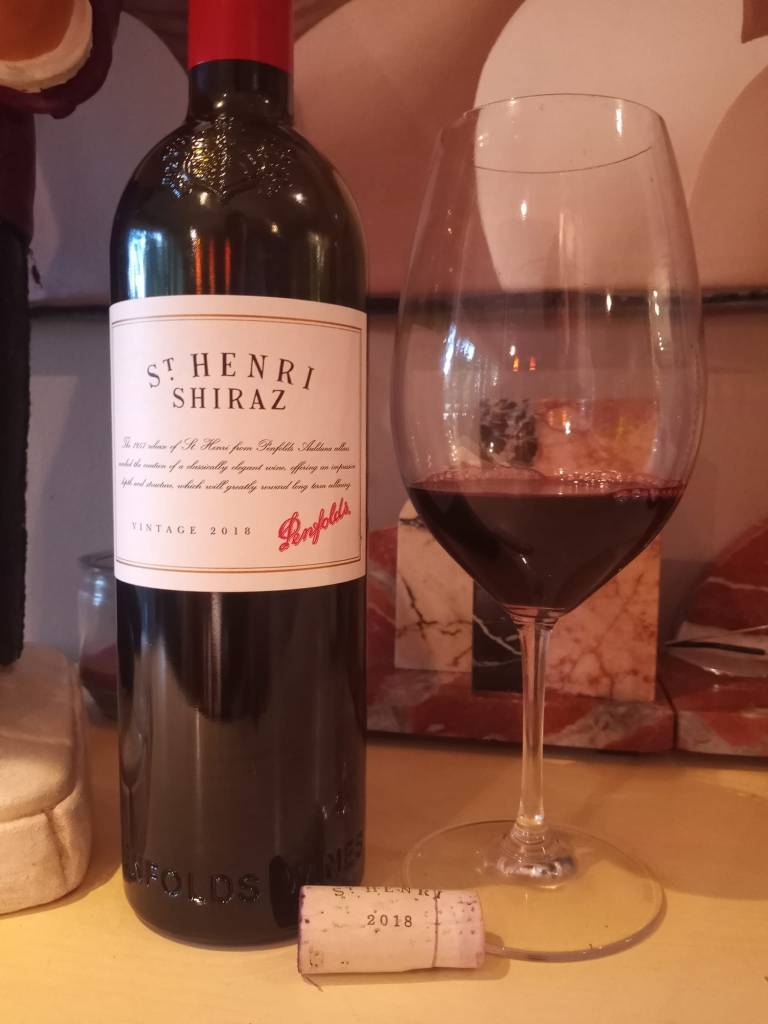
Penfolds St Henri Shiraz 2018- one of the best I have tasted!

There are few things I look forward to more than a release of the new vintage of St Henri- one of my all-time favorite wines and most definitely my favorite Penfolds wine. I have been fortunate to have tasted 20 plus vintages and it’s like sitting down with an old friend you have not seen for a while- it’s always a pleasure.

Like most Penfolds wines, this is a multi-regional blend, of 100% Shiraz, sourced from Barossa, McLaren Vale, Port Lincoln, Robe, Padthaway, Clare Valley and Adelaide Hills grapes drawing characteristics from every vineyard and region. The boldness of Barossa, the elegance of McLaren Vale and Clare Valley and a hint of individual quirkiness from each of the other regions. 

Released for the first time by Penfolds in the early 1950s (first commercial vintage 1957), it gained a new lease of life in the 1990s as its quality and distinctive style became better understood. Source: www.penfolds.com

A wine so totally individual and unaffected by trends, it is unashamedly confident in its character. This is a big, bold wine with a ton of character while being elegant and restrained with incredible balance. I initially decanted this for 5 hours, and it was amazing, revealing its further potential as it unwound. I then left it for a further 24 hours with just the cork in, no air removed at all, for further aeration, with spectacular results.

The nose is most definitely seductive and complex, with ripe blackberries, pencil shavings, and plums, along with a smattering of red and blue fruits and earthy notes in a supporting role.

The palate has a creamy, smooth mouthfeel, graceful, and immediate appeal. Layers of rich, ripe blackberries, raspberries, plums, and dark cherries dominate, with dark chocolate, sweet spices, tobacco, subtle black pepper, and leather rounding things out. As you would expect, the finish is very long.

Pair with something special, a red meat dish with roasted vegetables and Italian herbs.  

This is drinking well now, with some serious decant time but cellaring out will bring immense rewards- 35 years and beyond.

Elderton Command Single Vineyard Shiraz 2001

Make no mistake, this is a remarkable Shiraz.

Not unlike many Bordeaux Chateaux, this has changed hands several times over the past 130 years.

The original vines were planted in 1894 by early German settlers, the Scholz family, then in 1916, Samuel Elderton Tolley purchased the vineyards and named it Elderton. He built a sprawling homestead, grew grapes, and sold them to his family winery. The Winery did well until the early 1970’s suffering from a vine pulling program and became derelict.

Around 1975, Lorraine and Neil Ashmead were offered the house for sale, and he offered to throw in the 72 acres of old vines for nothing. Tireless work with meticulous precision and the classic old vines were resurrected to their former glory, with the first wine under the Elderton label being released in 1982. Fourteen years later, in 1996, they won Best Shiraz in the World at the London International Wine and Spirit Competition, establishing themselves as a force to be reckoned with in the valley. 

The 2001 is the 16th release of the single-vineyard Command Shiraz, spending 3 years in French and American oak and a year in bottle aging.   

The aromas from the glass are an intoxicating, seductive Perfume, very complex, with blackberries, vanilla, and chocolate taking center stage.

The palate is remarkably smooth, with exceptional balance, and broad shoulders cradle elegance and finesse. Rich, seamless layers of vanilla, blackberries, plums, oak, cherries, with hints of dark chocolate, spices, and coffee. So much depth and complexity. Everything is exactly where it should be, and the 15% Alc. is not at all noticeable.

The body and structure are impeccable, so I can see this cellaring out to 2030 to 2035. It is drinking so well now, though. I still have two more bottles in the cellar, so look for an update in years to come.

Wine Spectator rated this 96 Pt in 2005.

I have said this before, but just make sure whatever you pair with this is worthy. Red meat for sure.

Nielson Pinot Noir 2022

The winery was named in tribute to Uriel J. Nielson, who planted the first commercial vineyard in 1964, in Santa Barbara County. Against the grain and a ton of advice, this region was considered far too cold to grow grapes. His forward thinking planted the seeds for an excellent wine AVA perfectly suited for both Pinot Noir and Chardonnay. There are now over 100 vineyards and thousands of acres of vines planted and is critically recognized for its quality, uniqueness, and location-driven wines.

Their winemaker Anne Clifford is somewhat of a local, growing up in Thousand Oaks, about two hours south of Santa Maria. Few people have their parent’s support to follow their dream; she had their full support and encouragement to attend U.C. Davis to study winemaking.

She also travels to New Zealand in the off-season to make, you guessed it, Pinot Noir.

This is a blend of 60% Monterey County and 40% Santa Barbara County fruit. These vineyard sites gain the benefit of coastal influence in the form of morning fog and cooler afternoon breezes that keep the fruit protected and cool as they ripen.

Alluring aromas of dark cherries, pomegranate, and tea draw you in.

The palate has depth and complexity wrapped in a silky-smooth mouthfeel that feels balanced and natural. Enticing layers of dark cherries, cranberries, black tea, cola, pomegranate, and spices on a lengthy finish. Acidity is prominent but not overwhelming. An hour in a decant or a few more years in the cellar will settle that. Matt finish tannins and bright fruit round things out.  

Cellar out to 2030 with confidence.

Pairings should include Salmon, Chicken, Pork, and Duck.

Cult Cabernet Sauvignon 2022 – the Beau Vigne Collection.

The bottle and label scream elegance, but have you tasted this before?

Ed and Trish Snider started the winery almost 30 years ago with Dave Phinney at the winemaking helm. They had a simple aim: to make wine that would compete with the greatest wines in the world. Kirk Venge came onboard as winemaker in 2008, producing wines that received scores ranging from 93 to 100 points. This wine is part of that vision.

In 2019, Charles Bartlett became the new owner, appointing Julien Fayard, of Château Lafite-Rothschild, Château Smith Haut Lafitte, and Atelier Melka fame, as head winemaker, quickly establishing his stellar reputation in the Napa community.

The Beau Vigne Collection continues the tradition and vision to create exceptional wines, sourcing grapes from Atlas Peak, Pritchard Hill, as well as Howell Mountain, Oakville, and Rutherford. Mountain fruit is favored because of the natural restraint and finesse inherent in the terroir. 

Seductive aromas of blackberries, plum, and oak draw you in, making promises you pray the first sip will deliver.

The palate is smooth and inviting, with depth and complexity evident, as well as impeccable balance and well-integrated tannins. Interwoven layers of blackberries, cassis, plums, vanilla/oak, and dark chocolate, with secondary layers of blueberries, dark cherries, and baking spices. There is a rich, velvety mouthfeel, and not from overripe fruit, that is balanced with proportional acidity. As I said, everything is in balance and where it should be.

Cellar time: 2035 with confidence.

Food pairings should include red meat- just make sure it is worthy of this wine.

There is an unconfirmed rating of 94 Pt. I read it somewhere months ago and cannot find it again, of course.

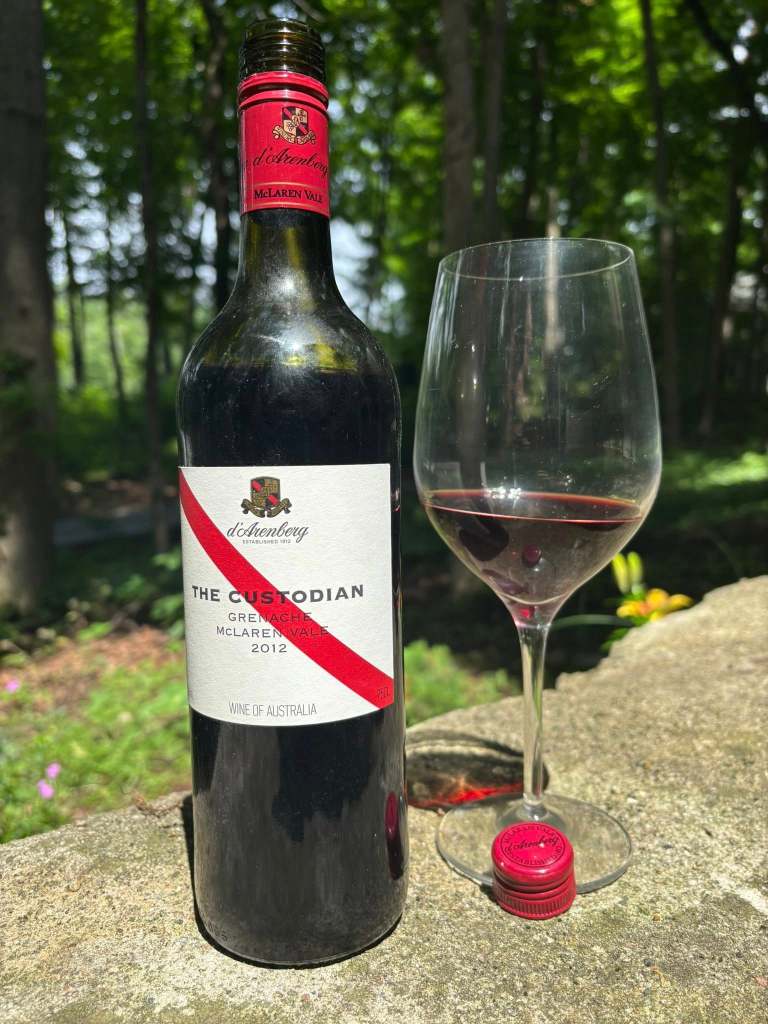
d’Arenberg ‘The Custodian’ Grenache 2012.

d’Arenberg does not have the oldest Grenache vines in the world, but they are close. This family business, since 1912, has played the role of custodians of old vine Grenache – about 135-year-old vines- and holds about 1/3 of the old vines in McLaren Vale. Chester, fourth generation Custodian of the winery, took over the winemaking reins in 1984, now passing the baton onto Jack Walton. 

Up until the early 1970’s Grenache was the most widely planted grape in Australia, then Shiraz took over.

The nose is loaded with dark cherries, red plums, and blueberries, and quietly seduces you to take a sip.

The palate is dominated by red plums, blueberries, mulberries, savory notes of beetroot and spices with traces of red cherries, and cinnamon. Mouthfeel is soft and inviting confirming 13 years of aging has smoothed out ‘jagged edges’ with tannins and acidity sitting exactly where they should be, confirming both age ability, and balance that stands the test of time. The 2012 vintage was an excellent vintage, producing a score of 94 Pt – James Halliday. Not bad for a $20 wine.

No prize for knowing where the name came from.

This has another 2 – 3 years of aging before it hits its drinking peak.

Grenache loves spicy foods, so pairings should include dishes like Chicken and Chorizo Paella, Gourmet Burgers from the grill, Turkey, Grilled Kangaroo, Roast Pork, and just about any red meat from the grill.

Yalumba The Tri-Centenary Barossa Grenache 2012.

This majestic wine is sourced from some of the oldest Grenache vines in the world, planted in 1889, and imposes elegance and finesse on the drinker from the first sip.  This really is a classic wine and a pleasure to drink. From its almost translucent satin red color that shimmers to the enticing aromatics of raspberry, red currents, and cherries, this delivers a special experience.

The 2012 vintage received a string of 95 and 96 Pt ratings from Australian and US reviewers alike reflecting the benchmark standard for this exceptional wine. The grapes were sourced from 820 gnarly old bush vines planted in 1889. These are not the oldest Grenache vines in Barossa but they are close. That honor belongs to Cirillo Estate further down the road in Barossa, planted in 1850.

The nose is seductive, with aromas of raspberries, cherries, and pomegranate, as well as a hint of oak and darker fruits. There is so much going on.

The palate is rich and lush, silky smooth showcasing excellent balance, fine grain tannins, and lively acidity that walk hand in hand framing seamless layers of dark raspberries and cherries, blackberries, plums, and a sweet raisin note. Secondary notes of vanilla, oak, chocolate, and herbs round things out—wonderful texture on the palate through to a long finish.

Pair with any game, with a red fruit wine reduction sauce, chicken, braised pork or lamb, stews, lighter Indian dishes, and of course Turkey- remember this for next Thanksgiving.

I believe this can be cellared out for another 6 – 8 years with confidence.

What has 42 ha and 70 plots and is delicious to drink? …

Chateau de Pez of course!

About the Winery …

It is possibly the oldest Bordeaux wine-making estate in the Saint Estéphe appellation, rivaled only by Chateau Calon Segur. The Chat. de Pez estate was created in 1452 by Jean de Briscos and has since passed through many owners with Jean-Claude Rouzaud being the current owner and custodian since 1995. If you are curious about the name, he is best known for the Roederer Champagne, the maker of Champagne Cristal, as well as owning Pichon Comtesse de Lalande in Pauillac, Chateau Bernadotte, and Chateau Haut-Beausejour.

The vineyards are 48% Merlot, 46% Cabernet Sauvignon, 4% Cabernet Franc, and 3% Petit Verdot planted on gravel, limestone, and clay soils. A 17-meter altitude difference produces excellent drainage for the vines, which are an average of 25 years old. Their average annual production is around 18,500 cases.

Due to substantial investment reflecting the jump in quality, the Chateau has had a string of outstanding vintages from 2014 to the current vintage- 2023.

Chateau de Pez 2021   

The 2021 vintage is a blend of 51 % Cabernet Sauvignon, 43 % Merlot, 3% Cabernet Franc, and 3 % Petit Verdot.

Expressive aromas of ripe red cherries, wildflowers, plums, blueberries, and spices.

The palate is inviting, silky smooth, almost creamy, with enticing ripe dark cherries, blueberries, blackberries, red plums, and dark chocolate dominating with savory/earthy notes, coffee, olives, and spices.  

This wine displays impressive depth and complexity with great balance and acidity. Tannins still give a dryish pucker, after all, it is only 6 years old. I anticipate this will soften in the coming years, 2 -3 hours of decanting in the meantime. This was impressive drinking day 2 with just the cork back in the bottle.  

This will cellar out to 2035 nicely with marked anticipated improvements.

Winery recommends the following pairings: veal, pork, beef, lamb, duck, game, roast chicken, roasted, braised, and grilled dishes as well as mushrooms, pasta, and cheese. Chateau de Pez is also quite good with Asian dishes, and hearty fish courses like tuna, mushrooms, and pasta.

Wine Enthusiast gave this 94 Pt rating.

Lapostolle Curvée ‘Alefandre’ Merlot 2012 – from the cellar.

About the Winery …

Yet another Chilian Winery with French roots. The winery was established in 1994 by Alexandra Marnier Lapostolle and her husband Cyril de Bournet. Alexandra is from the renowned Marnier Lapostolle family, that has for several generations dedicated itself to making high-quality wines and spirits. In other words, French winemaking philosophy with the magnificent terroirs of Chile. Today Charles-Henri de Bournet, from the 7th generation of the family, is at the helm of the Domaine.

About the Vineyards …

The Apalta Valley is a horseshoe shaped valley surrounding the vineyards, near the city of Santa Cruz, and just over 100 miles southwest of Santiago and benefits from a north-south exposure, something rare in Chile. The vineyards are planted on very ancient soils originating from the Cretaceous period, featuring granitic and granodioritic material, with angular stones and underlying clayey subsoils on the hills. The flatter areas, next to the Tinguiririca River are composed of colluvial and some older alluvial material courtesy of the river.

About the wine …

This is a blend of 85% Merlot and 15% Carmenere, and is aged in French Barrels for 9 months with 59% in new oak and the balance in second and third use. Almost 12,000 cases produced.

Enticing aromas of violets, blueberries, olives, chocolate and just a hint of herbs.

The palate is smooth and inviting with obvious depth and complexity. Interwoven layers of blackberries, blueberries, dark cherries, chocolate, and plums, with just a hint of dark raspberries and spices.  

Excellent balance with everything in place, and just a hint of sweetness on a long finish. Tannins still resolved in their duties.  

This still has 3 – 5 years before hitting its peak.

Winery recommends well-seasoned dishes with a red wine demiglace such as short ribs and angus beef to pair with this wine. I would consider Filet Mignon, Spaghetti and meatballs, Duck, or Turkey.

Have you tasted a Zibibbo? – drink like Cleopatra.

Tonnino Zibibbo 2021

This 100% organic Zibibbo is from Sicily, planted on soil rich in limestone, sand, and organic elements. It is known predominately as a sweet wine that falls into the Muscat family and is also known as the ‘Muscat of Alexandria’.

This is a dry version and infinitely drinkable- be warned.

It is believed to have originated in Northern Africa and arrived in Sicily via Greece. Despite being produced in several countries today, including Spain, South Africa, California, and as far away as Australia, it still flies under the radar and is relatively unknown outside of Europe.

It was rumored to have been Cleopatra’s favorite wine. 

This family-run winery was started by Grandfather Paolo back in 1950. It took a few decades until the decision to make their own wine became a reality. Today, the third generation is focused on doing things as their grandfather taught them- hand pruning, hand picking, and paying back to the land that gives them bountiful grapes to make impressive organic wine. Grandfather would be proud.

This highly aromatic white wine showcases alluring notes of White flowers, and citrus- lemons and orange zest, with just a hint of apricot.

The palate is enticing, almost seductive, with a rich fruit-driven mouthfeel balanced with crisp acidity. Think back to when you tasted your first Gewürztraminer, a similar experience. An almost pear-like texture dominates framing layers of ripe lemons, orange zest, apricot, pear, and just a hint of almond and lychee on the finish. Impressive depth and complexity, amazing balance, and loads of character and attitude.

It makes you want to have another sip the second you finish your first. This pretty much ticks all the boxes and is a must-try white.

This should cellar out to 2030 without a problem.

Pairings should include, shellfish, scallops, fish- swordfish in particular, chicken, and pork.