I published this article a few years ago and have been asked several times in recent weeks to post it again …
When I first decided to touch on the topic of French Wines, I thought it was a great idea and I slowly came to realize I’ve lost my mind. It is such an infinitely complex topic hindered by French ‘rules’ and classifications with labels that tell you next to nothing … but here goes.
There is a signpost with some basic facts that should be considered. Firstly, of all it’s all based on regions as opposed to grape varietals- what that means is there is no Chardonnay’s- they are Chablis’s or Pinot Noirs- they are Burgundy Red’s because they are named after the town in which they are grown around or the region they are grown in. This category system is wrapped around a French concept called “terroir” which really means a recognition of the environment and its role on influencing the final flavor profile of the finished wine. A belief system predisposed to the notion that vineyards adjacent to each other are so different as to demand separate classifications. Just for the record there are of course noticeable differences between most vineyards. I guess the real question that I’ve heard asked: are there enough to justify a classification system?
The system actually dates back to 1855 and the original concept, some say was inspired by the British Monarchy who purchased vast quantities of Bordeaux wines, which they called Claret. In reality, it was the Gironde Chamber of Commerce who ordered an official classification inspired by Napoléon III and his desire to showcase the best of France at The Exposition Universelle de Paris.
This system identified 5 levels or ‘Growths’ covering 61 different Chateaux’s- this of course assists modern day wine brokers immensely.
Moving right along, from a Bordeaux perspective the classification system was based around the concept of quality separating the best from the rest as we will see from the chart below …
The US President, Thomas Jefferson was also a wine lover and during his visit to Bordeaux in 1787 came up with his own ranking: “There are four vineyards of prime quality:
1. Chateau Margaux, belonging to the Marquis d’Argicourt, who produces around 150 barrels that were sold by contract to a merchant named Jernon.
2. La Tour Segur, (Chateau Latour) in Saint-Lambert, belonging to Mister de Miromesnil, who produces 125 barrels.
3. Haut-Brion, two-thirds of which belong to the Count de Fumel who sold the harvest to a merchant called Barton. The other third belongs to the Count of Toulouse; in all, the château produces 75 barrels.
4. Chateau de la Fite, (Chateau Lafite Rothschild) belonging to President Pichard of Bordeaux, which produces 175 barrels”. Source: www.thewinecellarinsider.com
What is a Claret?
The word claret is an anglicized version of the French term clairet – which is a dark rosé wine typical to Bordeaux. The term has evolved since its first use in Britain to refer to dry, dark red Bordeaux wines. It is associated with the upper class.
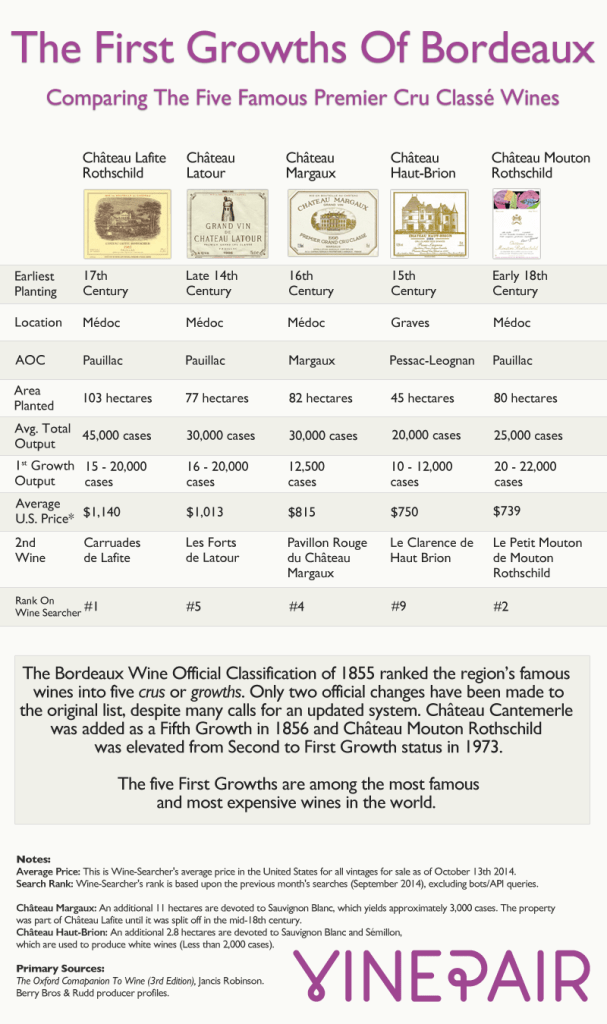
Source: http://www.vinepair.com
History dictates that change in inevitable and the classification system in not immune, at least in terms of inclusions. In 1973 Mouton Rothschild was elevated from Second Growth classification to First Growth. Technically there are two other ‘First Growth’ or Premiers Crus if you include white wines from the commune of Sauternes and Barsac.
In 2012, the St Emilion Classification was expanded to include Chateau Angelus and Chateau Pavie.
I have included below a ‘top 5’ of the remaining Growth listings. For a full listing as well as Whites go to Source: www.wikipedia.com There are just too many to include here.
| Second Growth’s Include- | Third Growth’s Include- |
| Château Rauzan-Ségla, Margaux. | Château Kirwan, Cantenac-Margaux. |
| Château Rauzan-Gassies, Margaux. | Château d’Issan, Cantenac-Margaux. |
| Château Léoville-Las Cases, St.-Julien. | Lagrange, Château Lagrange, St.-Julien. |
| Château Léoville-Poyferré, St.-Julien. | Château Langoa-Barton, St.-Julien. |
| Château Léoville-Barton, St.-Julien. | Château Giscours, Labarde-Margaux. |
| Fourth Growth’s Include- | Fifth Growth’s Include- |
| Château Saint-Pierre, St.-Julien | Château Pontet-Canet, Pauillac. |
| Château Talbot, St.-Julien. | Château Batailley, Pauillac. |
| Château Branaire-Ducru, St.-Julien. | Château Haut-Batailley, Pauillac. |
| Château Duhart-Milon, Pauillac. | Château Grand-Puy-Lacoste, Pauillac. |
| Château Pouget, Cantenac-Margaux | Château Grand-Puy-Ducasse, Pauillac |
| Whites- First Growth’s Include- |
| Château d’Yquem, Sauternes- Superior First Growth (Premier Cru Supérieur). |
| Latour Château La Tour Blanche, Bommes (Sauternes). |
| Château Lafaurie-Peyraguey, Bommes (Sauternes). |
| Château Clos Haut-Peyraguey, Bommes (Sauternes). |
| Château de Rayne-Vigneau, Bommes (Sauternes). |
2021 UPDATE:
Up until recently the following grapes have been the only approved varieties allowed to be grown in Bordeaux: Cabernet Sauvignon, Cabernet Franc, Merlot, Malbec, Carmenere, Petit Verdot, and the whites being Semillon, Sauvignon Blanc, Sauvignon Gris, Muscadelle, Colombard, Ugni Blanc, Merlot Blanc, and Mauzac.
In recognition of climate change and pro actively looking to the future for ‘suitable’ varietals that will grow in warmer conditions, the following grape have recently been approved for plantings in Bordeaux: Arinarnoa, Castets, Marselan, and Touriga Nacional—and two whites—Alvarinho and Liliorila.
Regarding the reds, Arinarnoa is cross between Tannat and Cabernet Sauvignon, Castets is consideres by many as a “long-forgotten Bordeaux grape.” Marselan is a cross between Cabernet Sauvignon and Grenache and Touriga Nacional is a late-ripening Portuguese grape.
Regarding the whites, Alvarinho is Portuguese and more commonly known as Albarino and Liliorila is a cross between Chardonnay and Baroque originating from France.
 Vine to Table